How to host a gingerbread house decorating party
How to host a gingerbread house decorating party: how many kits you need, candy per house, a candy sign-up so guests do not all bring gumdrops, judging categories and awards, and a timeline.
A gingerbread house party is easy to love and easy to under-supply. Guests arrive excited, and the host is the one who has to make sure every builder has a base, icing and enough candy. This guide covers what to settle, in order: kits, candy, a judging plan and a timeline.
Step 1: Count builders, then houses, then kits
Start with who is actually building. Hosts, judges and watchers do not need a kit. Then decide how many builders share a house: young children usually build better in pairs, and a family can share one house. Houses are builders divided by builders per house, rounded up, and kits are houses plus a few spares for cracked walls.
| Builders | Builders per house | Houses | Kits with 2 spares |
|---|---|---|---|
| 8 | 1 | 8 | 10 |
| 8 | 2 | 4 | 6 |
| 12 | 2 | 6 | 8 |
| 20 | 2 | 10 | 12 |
Pick the spare count before you buy. Two spares is a comfortable default for a small party, and a store-bought kit that is already built is a reliable backup for the guest whose roof slides off.
Step 2: Work out the candy per house
Decide how many cups of candy each house gets, then multiply by the number of houses. Ten houses at two cups each is twenty cups to gather. The mix matters as much as the amount: you want some of everything, not eight bags of the same gumdrop.
- Walls and roofs: royal icing in piping bags, plus candy canes, pretzel sticks or wafers.
- Roof tiles: small flat candy such as candy-coated chocolates, cereal squares or sliced candy.
- Trim and path: gumdrops, peppermints and sprinkles.
- Extras for small hands: marshmallows, mini cookies and shredded coconut for snow.
Step 3: Use a candy sign-up so guests do not all bring the same thing
Ask guests to claim a candy and say how many cups they will bring. Keep one list with a row per candy: who is bringing it, what it is, how many cups, and whether it has nuts or gluten. You see duplicates while it is still easy to swap, and you can add up cups pledged against cups needed.
| Column | What goes in it | Why it helps |
|---|---|---|
| Guest | Who is bringing the candy | Someone to thank, and someone to chase |
| Candy | The one kind they claim | Stops eight bags of gumdrops |
| Cups | How many cups they will bring | Adds up against the cups you need |
| Nuts or gluten | A yes or no in the guest’s words | Feeds the allergy labels |
If a guest has a nut allergy, flag it on the same list. A candy with nuts should be labelled, and the table where that guest builds should stay clear of it. Ask each guest to confirm what is in the candy they bring: a label is only as good as what you are told.
Step 4: Decide how judging will work
Judging keeps a decorating party fun instead of awkward, as long as the rules are set before anyone picks up a piping bag. Name your categories in the invitation, keep the number small, and give every house a number rather than a name so judges are not scoring their friends.
- Pick about five categories, such as most creative, best use of candy, neatest, most festive and funniest.
- Score each category on one scale for every house, such as 1 to 5, and add the scores up.
- Split into divisions (kids, teens, adults, family) so a six-year-old is not judged against a competitive baker.
- Decide how to break a tie before you need to: for example, judges revote on the tied houses only.
- Give every builder something to take home, even if it is just a ribbon.
Step 5: A timeline, counted back from the party
- Three weeks before: choose the date, count likely builders and send the invitation with the candy sign-up.
- Two weeks before: confirm replies and allergies, fix the kit count and order or bake the bases.
- One week before: tally the candy pledged against the cups needed and fill any gaps yourself.
- The day before: bake or buy the spares, set out tables and mix the royal icing.
- On the day: set up one station per house with a base, icing and a shared candy tray, then start the clock on building.
- At the end: judge, hand out awards and send guests home with their houses in boxes.
Would a ready-made planner save time?
The Gingerbread House Decorating Party Planner puts this guide into a spreadsheet. It works out kits from your builders and houses, adds up candy cups needed against cups pledged, tracks RSVPs and allergies for up to 100 guests, scores up to 40 houses in five categories you can rename, and dates a party timeline back from your party. The Cookie Exchange Party Planner suits a baking swap, and the Holiday Open House Planner suits a drop-in party. Each Etsy download includes blank and sample .xlsx workbooks and a PDF quick-start guide, for Excel or Google Sheets. They are planning spreadsheets: they do not send invitations, take live RSVPs or provide the kits and candy.
Planners that do this for you
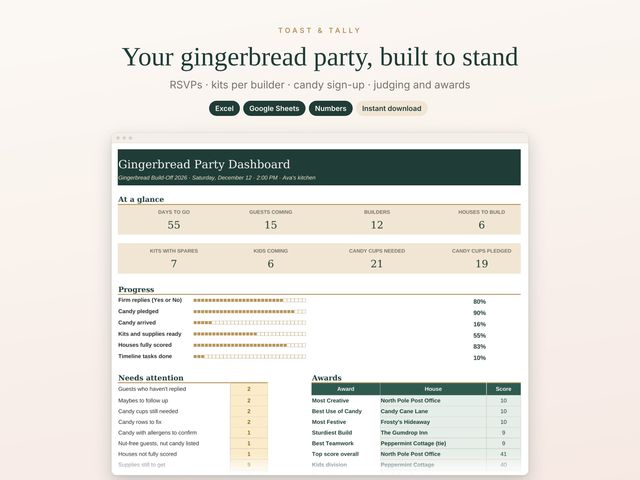
Gingerbread House Decorating Party Planner
$5.00RSVPs · kits per builder · candy sign-up · judging and awards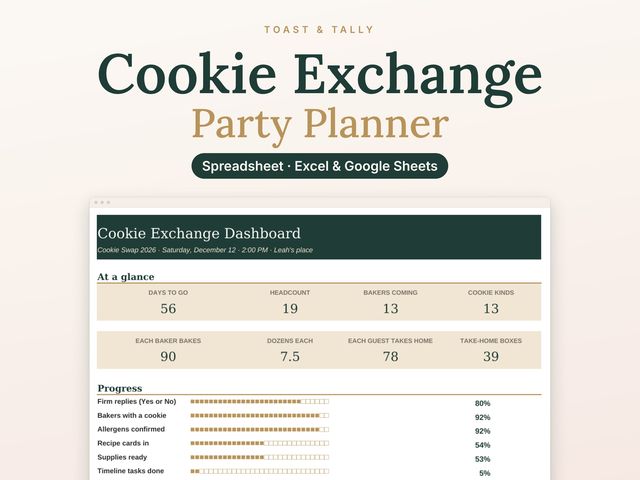
Cookie Exchange Party Planner
$6.00RSVPs · cookie sign-up · how many to bake · allergen flags · labels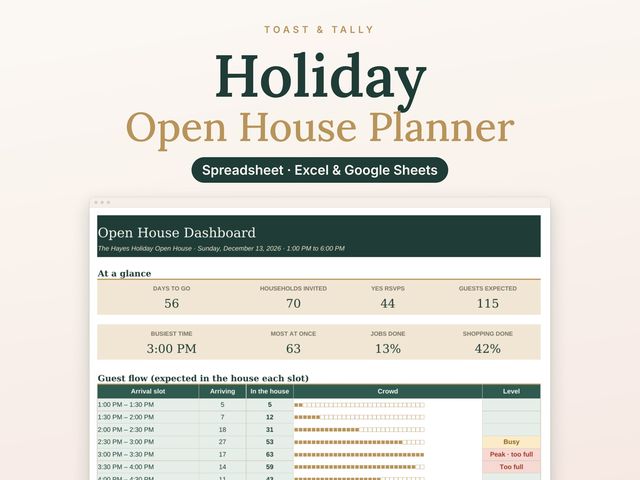
Holiday Open House Planner
$6.00Arrival slots · RSVPs · guest flow · refills · food for your crowdHoliday party planning checklist for home or work
Twelve Little Joys: try it free
Twelve small Christmas rituals for the whole family, one a day, with a little village that lights up as you go. Most take 10 to 20 minutes and need no supplies.
Updated 2026-10-29.