How to host a cookie exchange
How to host a cookie exchange: how many cookies each baker brings, simple rules, a sign-up so you do not get five of the same cookie, labels for allergies and what to do on the day. Free calculator included.
A cookie exchange works because every guest bakes one kind of cookie and goes home with a sampler of everyone else’s. The host’s job is small but important: set the numbers, set the rules, and keep the cookies from overlapping. This guide covers what to settle, in the order to settle it.
Step 1: Decide how many bakers and how many cookies each
Each baker brings one batch of a single kind, enough for every guest to take some home. The sum is simple: take the number of bakers (the host included, since you take cookies home too), multiply by how many cookies each guest takes home of each kind, and that is how many cookies each baker makes. If everyone goes home with half a dozen of each kind, 8 bakers means 48 cookies per baker, or 4 dozen.
| Bakers | Take-home per kind | Cookies each baker bakes | Each guest goes home with |
|---|---|---|---|
| 6 | 6 | 36 (3 dozen) | 36 cookies, 6 kinds |
| 8 | 6 | 48 (4 dozen) | 48 cookies, 8 kinds |
| 12 | 6 | 72 (6 dozen) | 72 cookies, 12 kinds |
| 12 | 3 | 36 (3 dozen) | 36 cookies, 12 kinds |
If you want a tasting table at the party, ask each baker for a few extra cookies to set out so guests can try everything without opening the take-home boxes. Past about ten dozen per person, baking turns into a weekend job, so with a big group ask for fewer of each kind or split into two smaller swaps. The free cookie exchange calculator does this arithmetic and prints a note for your guests.
Free cookie exchange calculator: how many cookies and batches each baker makes
Step 2: Write the rules before you invite anyone
Short rules, sent with the invitation, save every awkward conversation later. Most hosts cover the same handful of points:
- One kind of cookie per baker, and no repeats: ask guests to tell you what they are making.
- The number of cookies each baker brings, and whether the tasting table is included.
- Homemade only, baked in a clean kitchen, and no refrigeration needed during the party.
- Bring the recipe or a card listing the ingredients, so guests can see what is in each cookie.
- Bring your own container for the cookies you take home, or tell guests what you will provide.
- The date by which guests confirm and name their cookie.
Step 3: Use a sign-up so you do not get five of the same cookie
Keep a list with one row per baker: name, the cookie they are making, whether they replied, and any allergy they want you to know about. When two guests choose the same cookie, you find out while it is still easy to change. A sign-up sheet in a spreadsheet or on paper works equally well; the point is that one person holds the list.
| Column | What goes in it | Why it helps |
|---|---|---|
| Baker | Name of each guest bringing a batch | The headcount that sets quantities |
| Cookie | The one kind they are making | Stops duplicates |
| Replied | Yes, No or Waiting | Shows who to chase |
| Allergy notes | Nuts, gluten, dairy or other, in the guest’s words | Feeds the labels |
Step 4: Label every cookie
A small card by each plate, with the name of the cookie and the baker, is the part guests remember. Add a line for common allergens that the baker has told you about: nuts, gluten, dairy or egg. Ask each baker to confirm their own ingredients, and do not guess for them: an allergy flag is only as good as what the baker tells you.
Step 5: Set up the day
- Put out one table or one long counter, with a card at each place for each cookie.
- Give each guest a box or tin and a pair of tongs or a spoon, so cookies stay clean.
- Let everyone taste first, then fill their boxes, taking an equal share of each kind.
- Keep a few spare containers and a marker for the guest who forgets theirs.
- Have a short thank-you ready for the end, and a list of who brought what so you can thank them by name.
Hosting at work or at a school?
For an office swap, set the date, the number of cookies and the allergen-labelling rule in one message to the team, and name one person who keeps the sign-up. For a larger group, a smaller take-home number per kind keeps the baking fair; three cookies of each kind from 12 bakers is still 3 dozen for every person.
Would a ready-made planner save time?
The Cookie Exchange Party Planner puts this guide into a spreadsheet: it works out how many to bake, keeps guests, RSVPs and allergy notes in one list, flags nuts, gluten and dairy, prints cookie labels and sizes the supplies for your swap. The Gingerbread House Decorating Party Planner is built for a decorating party, with candy amounts for every house, judging and awards, and a dated timeline. The Holiday Open House Planner suits a drop-in party, with RSVPs and arrival times, a view of your busiest half hour and food sized to the crowd. Each Etsy download includes blank and sample .xlsx workbooks and a PDF quick-start guide, for Excel or Google Sheets. They are planning spreadsheets: they do not send invitations, take live RSVPs or bake the cookies.
Planners that do this for you
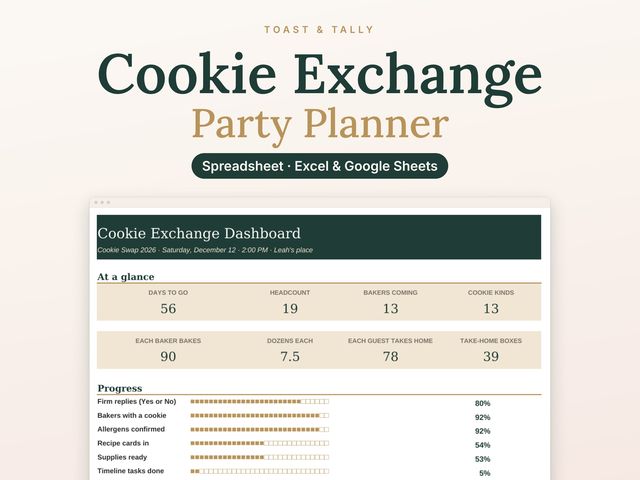
Cookie Exchange Party Planner
$6.00RSVPs · cookie sign-up · how many to bake · allergen flags · labels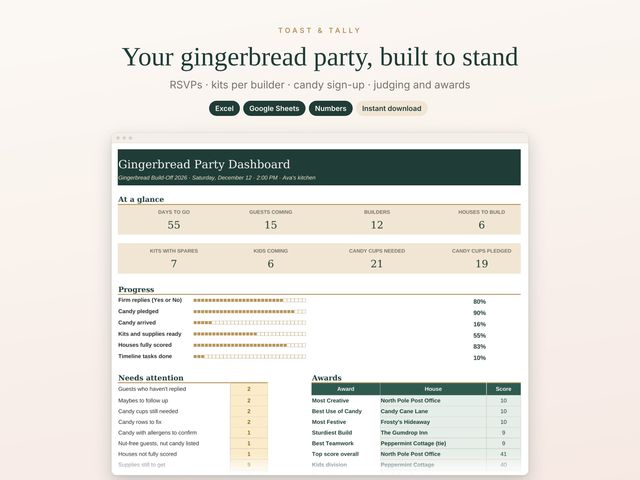
Gingerbread House Decorating Party Planner
$5.00RSVPs · kits per builder · candy sign-up · judging and awards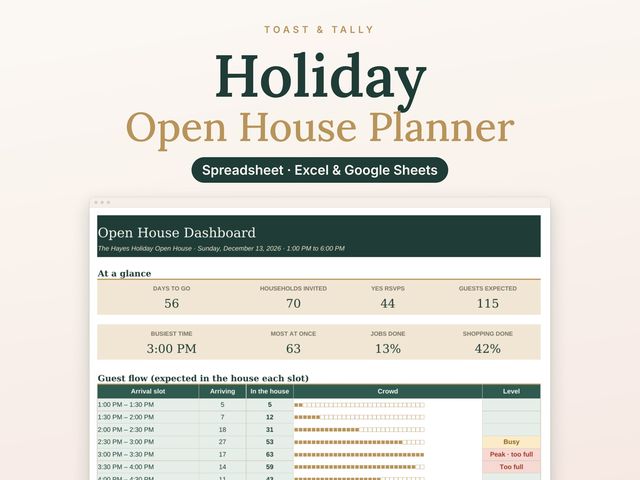
Holiday Open House Planner
$6.00Arrival slots · RSVPs · guest flow · refills · food for your crowd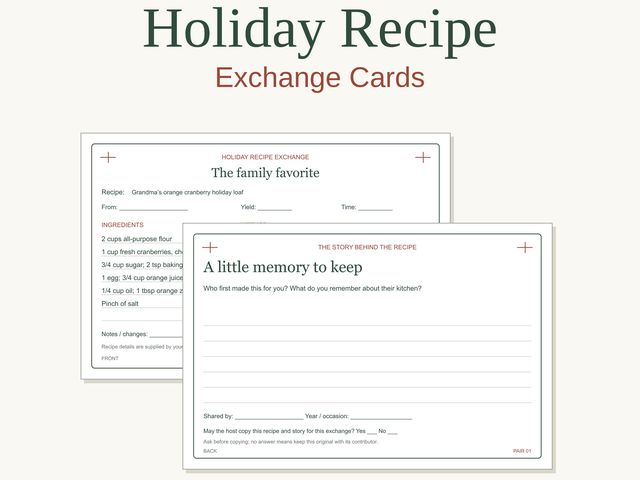
Holiday Recipe Exchange Keepsake Card Kit
$5.0012 recipe fronts + 12 memory backs, made for a guest exchangeHoliday party planning checklist for home or work
Twelve Little Joys: try it free
Twelve small Christmas rituals for the whole family, one a day, with a little village that lights up as you go. Most take 10 to 20 minutes and need no supplies.
Updated 2026-10-29.